
Why Choose a Cordless LED Desk Light for Your Workspace?
A workspace should support clear thinking, steady focus, and comfortable movement. A Cordless Led Desk Light can help achieve that without adding another cable to a crowded desk. It brings illumination exactly where needed, whether beside a notebook, near a keyboard, or on a small reading table. The difference feels simple. It can also be practical.
Lighting researcher Dr. Mariana Figueiro has said, “Light is the most powerful synchronizer of the circadian system.” Her observation highlights why desk lighting deserves more attention than appearance alone. A suitable lamp should offer stable brightness, comfortable color temperature, and controlled glare. These details matter when someone reads printed pages at 9 p.m. or reviews spreadsheets before sunrise. Battery life also deserves honest consideration. A cordless design is convenient, but it still requires regular charging. That small responsibility is easy to overlook.
The best choice depends on the workspace, eyesight, work duration, and personal habits. Adjustable brightness can reduce harsh contrast between a glowing screen and a dark room. A movable head can place light over the task instead of directly into the eyes. Still, no lamp solves every lighting problem. A compact model may feel elegant but provide limited coverage. A powerful model may create unwanted reflections. That trade-off matters.
This guide examines why a Cordless Led Desk Light can improve workspace flexibility, visual comfort, and desk organization. It also considers battery performance, color quality, stability, and long-term usefulness. The goal is not to praise every cordless lamp. It is to identify what genuinely helps.
What Is a Cordless LED Desk Light?
Why Choose a Cordless LED Desk Light for Your Workspace?
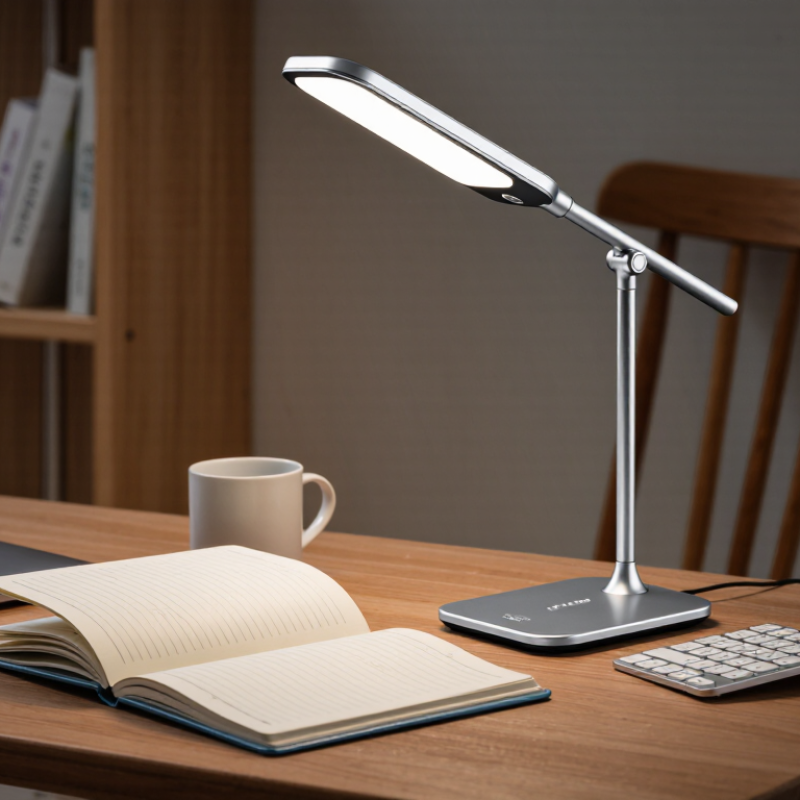
A cordless LED desk light is a compact task lamp powered by a rechargeable battery. It uses light-emitting diodes instead of traditional incandescent bulbs. This design removes the power cable from your desk. You can place the lamp beside a notebook, move it to a reading chair, or carry it during a power interruption. No cable is needed. That changes placement.
The U.S. Department of Energy reports that LED bulbs use at least 75% less energy and last up to 25 times longer than incandescent lighting. These figures explain LED efficiency, but they do not describe every cordless lamp. Battery capacity, charging time, brightness, and heat control still matter. Look for adjustable brightness and a stated color-rendering index. A CRI of 80 or higher usually supports clearer desk work, although personal preference remains important.
A cordless model also reduces visual clutter around keyboards and documents. During practical use, a stable base and smooth dimming can matter more than advertised brightness. The battery is the compromise. Frequent charging may become annoying, especially at maximum output. Battery performance can also decline over time. The International Energy Agency identifies lighting as roughly 15% of global electricity consumption, so efficient LEDs have a meaningful role. However, one small lamp will not transform energy use. It simply offers focused light, flexible placement, and a cleaner working surface.
Why Choose a Cordless LED Desk Light for Your Workspace? - What Is a Cordless LED Desk Light?
| Data Dimension | Typical Information | Why It Matters in a Workspace | Practical Notes |
|---|---|---|---|
| Definition | A rechargeable LED desk light that operates without a continuously connected power cable. | It can be placed wherever task lighting is needed, even when a wall outlet is not nearby. | Most models use an internal lithium-ion battery and recharge through a USB connection. |
| Light Source | Light-emitting diodes, commonly known as LEDs. | LEDs provide directional light and generally use less electricity than traditional incandescent bulbs. | LEDs also produce relatively little heat during normal use compared with incandescent lighting. |
| Typical Brightness | Approximately 200–500 lumens for many personal desk-lighting applications. | This range can support reading, writing, computer work, and close-up tasks when positioned correctly. | Actual illumination depends on the lamp height, beam angle, desk surface, and room lighting. |
| Color Temperature | Common adjustable settings range from warm white around 2700 K to cool white around 6500 K. | Warm light can create a relaxed atmosphere, while neutral or cool light can provide a more alert working environment. | A setting near 4000 K is often a balanced option for general desk work. |
| Battery Runtime | Often about 4–20 hours per charge, depending on brightness, battery capacity, and lighting mode. | A cordless light can continue working during short power interruptions or when moved between rooms. | Higher brightness normally reduces operating time. Check the manufacturer’s runtime rating at each brightness level. |
| Charging Method | USB charging is common; some products use USB-C and others use a dedicated charging connector. | USB charging makes it possible to recharge from a computer, power adapter, power bank, or compatible vehicle outlet. | Charging speed varies by the lamp’s charging circuit, battery capacity, cable, and power source. |
| Brightness Control | Many models offer multiple brightness levels or continuous dimming. | Adjustable brightness helps match the light to the task, time of day, and surrounding room illumination. | Lower brightness can reduce glare and extend battery runtime. |
| Color Rendering | A color rendering index, or CRI, of 80 or higher is commonly considered suitable for general indoor tasks. | Higher color rendering helps objects, documents, and printed materials appear closer to their natural colors. | For color-sensitive work, select a lamp with a clearly stated high-CRI rating. |
| Portability | Cordless designs can usually be moved without unplugging or rearranging a power cable. | They are useful for home offices, shared workspaces, study areas, bedside tables, and temporary workstations. | A compact base and a stable hinge or flexible neck improve portability and positioning. |
| Space Efficiency | The absence of a permanent power cable reduces cable clutter around the desk. | A clearer work surface can make small or shared desks easier to organize. | Cordless operation does not eliminate the need to recharge the battery regularly. |
| Eye Comfort Features | Some designs include diffusers, adjustable brightness, and flicker-reduction circuitry. | A well-diffused and appropriately positioned light can help reduce harsh reflections and uncomfortable contrast. | No desk light replaces good screen positioning, regular breaks, or suitable ambient lighting. |
| Best Use Cases | Reading, writing, laptop work, studying, crafting, travel, and backup lighting. | Its flexibility makes it practical for tasks that take place away from a fixed desk outlet. | For large rooms or whole-area illumination, a desk light may need to be supplemented by general lighting. |
| Key Selection Criteria | Brightness, runtime, charging interface, color temperature, stability, adjustability, and light distribution. | Evaluating these factors helps match the lamp to the user’s work habits and desk layout. | Prioritize the specifications that directly affect daily use rather than appearance alone. |
Note: Specifications are typical ranges for cordless LED desk lights. Actual performance varies by design, battery condition, operating mode, and surrounding environment.